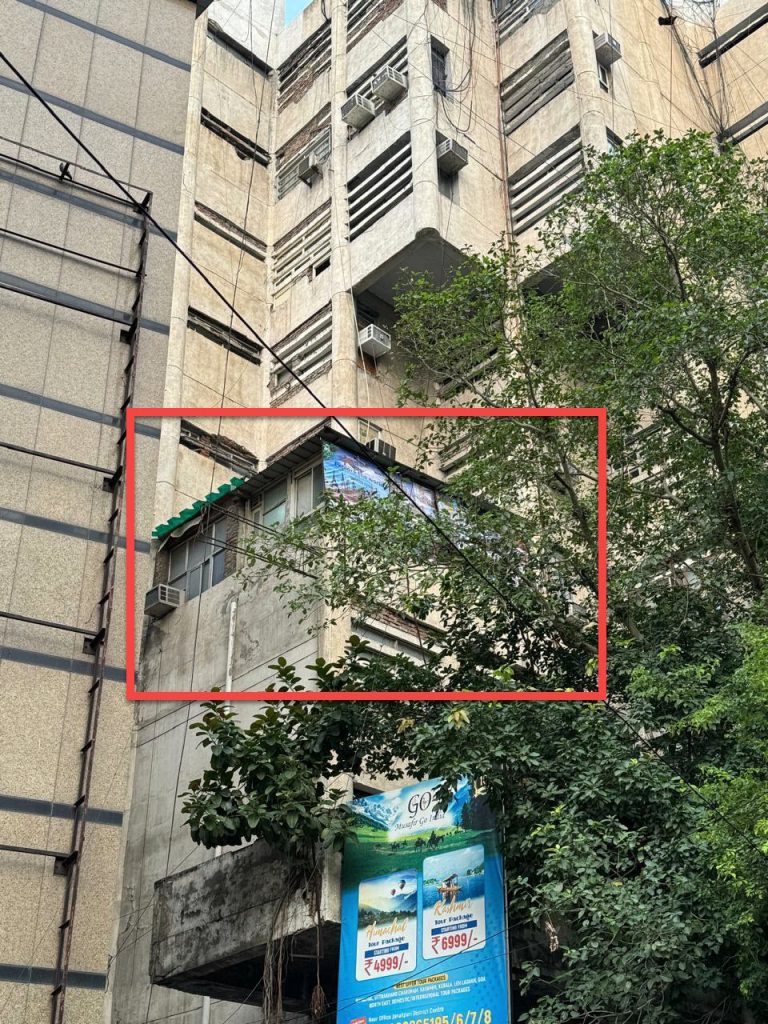
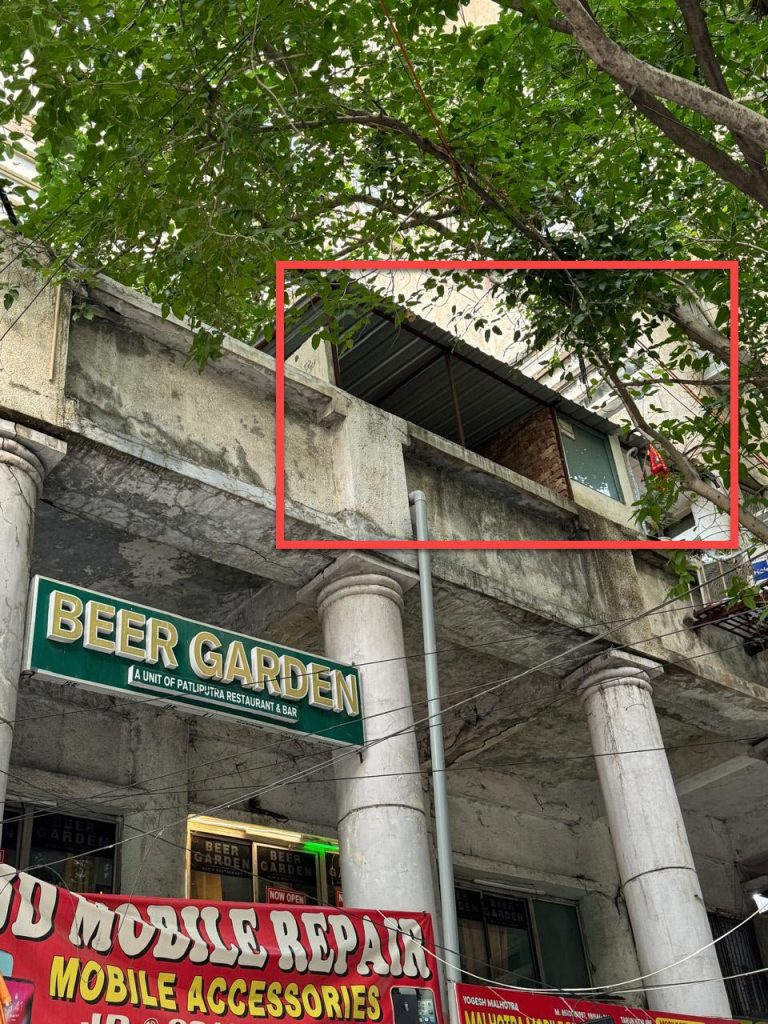
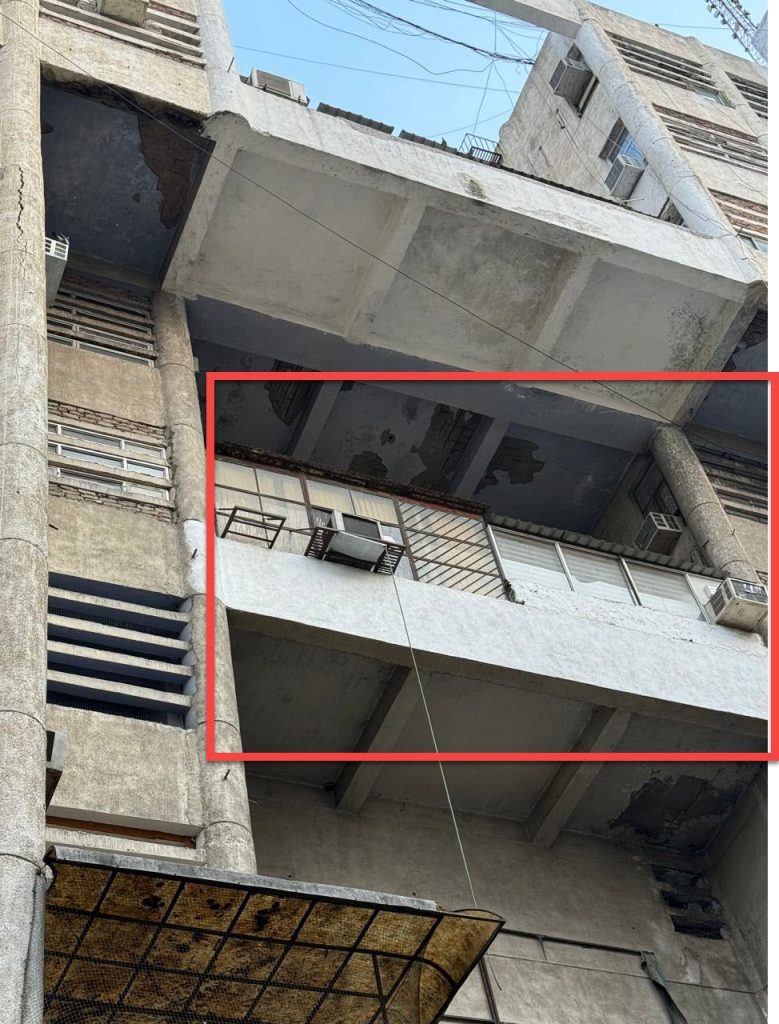
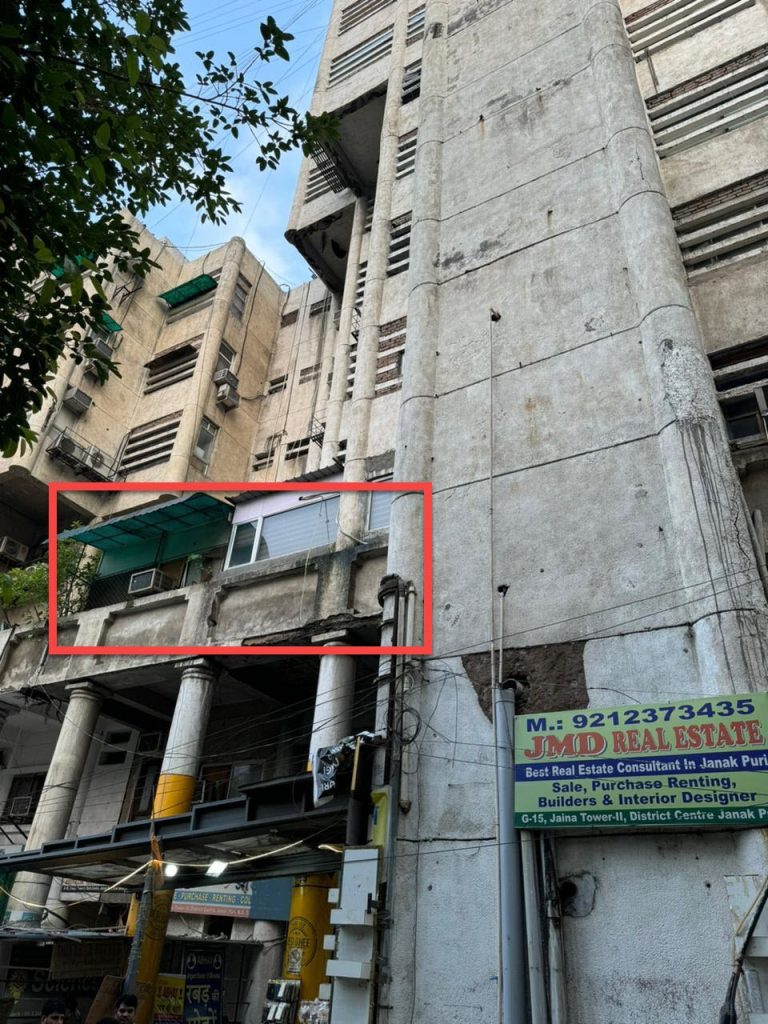
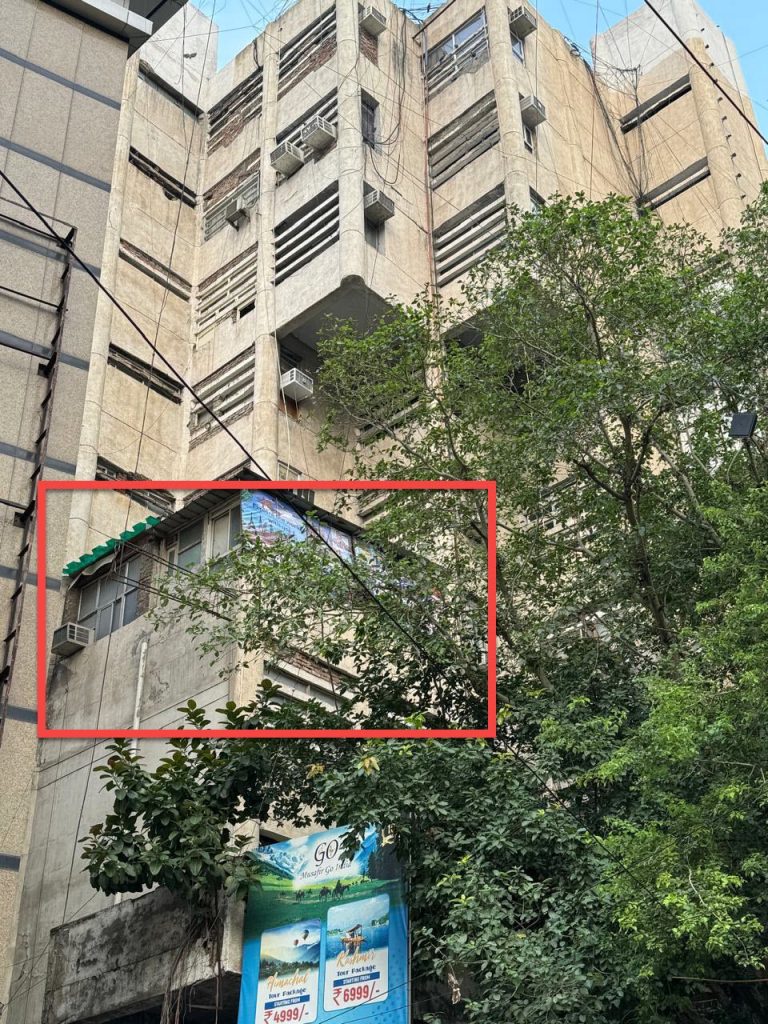
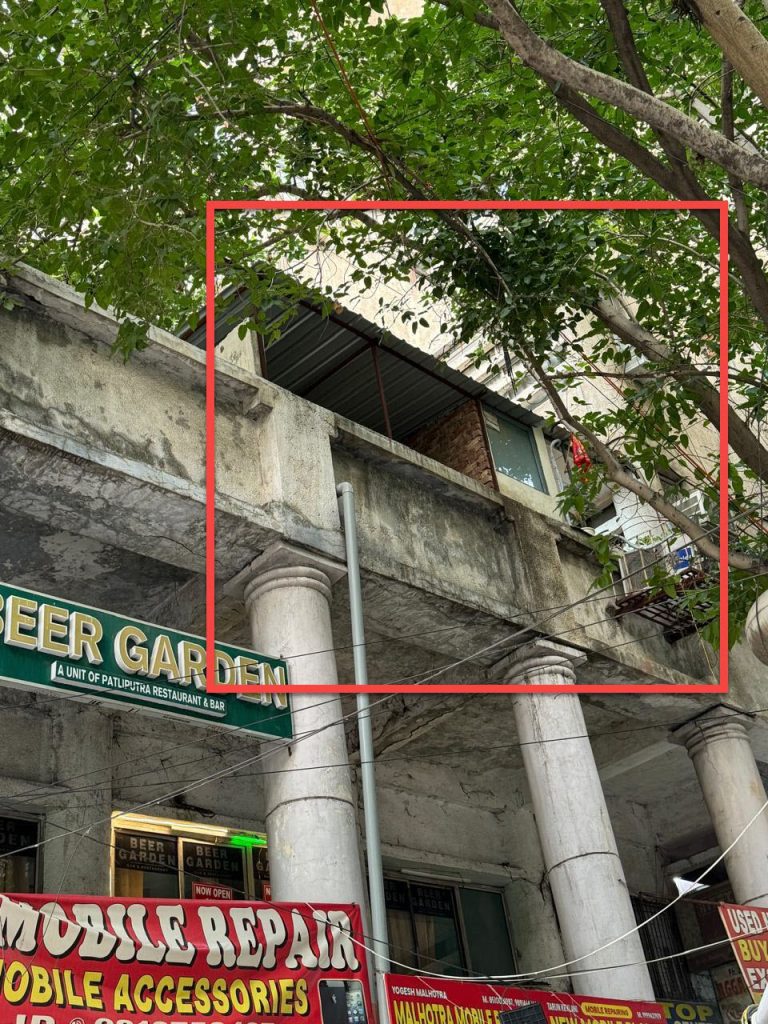
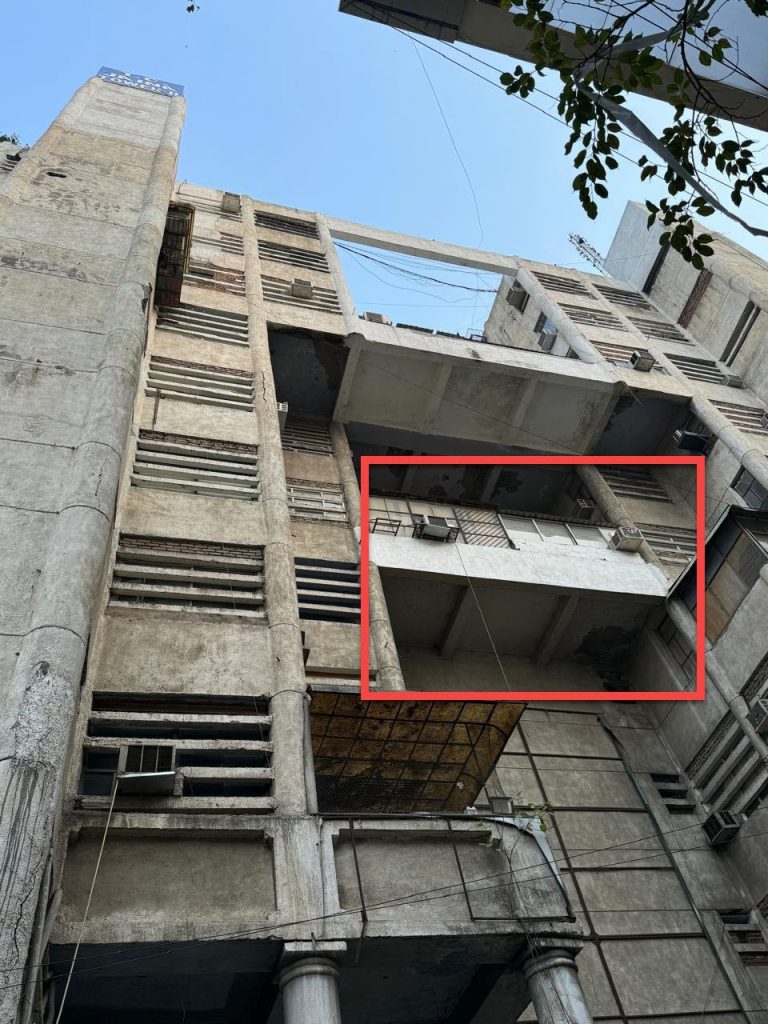
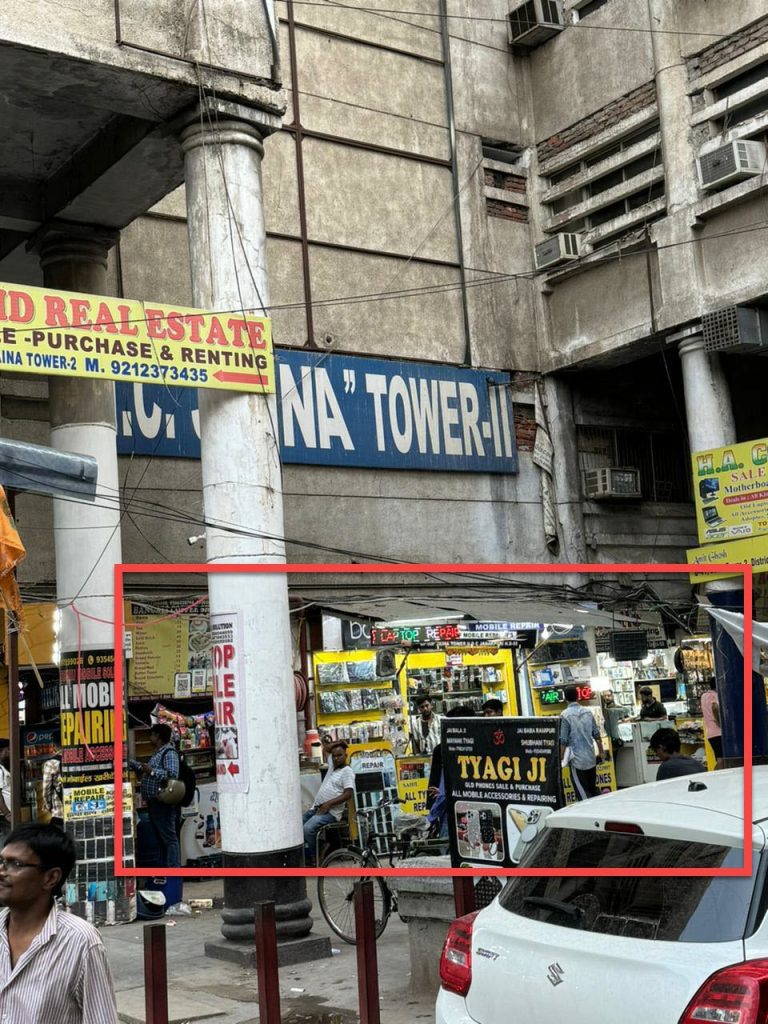
(Photos above were taken in July 2025 during a walk-through; red boxes mark the unauthorised portions.)
1. What was supposed to exist
| Location (as per sanctioned plan) | Intended purpose | Why it matters |
|---|---|---|
| Ground-floor colonnade / podium setback | Unobstructed pedestrian passage, access for fire tenders & ambulances | Clear egress saves seconds in an emergency; keeps columns free of eccentric loads |
| First-floor “refuge area” | Mandatory open platform where occupants can assemble while awaiting rescue (NBC 2016, Cl. 4.12) | Acts as a horizontal fire-safe zone, prevents stack-effect smoke spread |
| Cantilevered balconies & cavities above | Ventilation / façade relief only | Load-bearing members were sized for self-weight, not permanent rooms |
2. What exists today (from the site survey)
| Illegal addition | Where the photos show it | Immediate issues |
|---|---|---|
| Kiosk-sized shops welded between columns | Img 7 – mobile booth | Reduces corridor width to < 1.5 m, forcing shoppers into driveway; crowds escape routes |
| Closed-in offices on first-floor refuge deck | Img 4, 1, 8 – green-roof & aluminium glazing | Refuge area lost; extra weight sits on thin slab not designed for occupancy load (?3 kN/m² vs 0.75 kN/m² original) |
| Sheet-metal penthouses & brick infill in balcony pockets | Img 5 & 6 – underside shows patchy concrete and rusted channels | Adds un-engineered dead-load; traps rainwater ? rebar corrosion visible as spalling |
| Air-conditioner outdoor units perched on façade edges | Img 5 – split AC on protruding angle iron | Vibrations + point loads crack cover concrete; condensate drips onto electrical meter bank below |
3. Why this is a life-safety hazard
- Fire-service access throttled
- Delhi Fire Service Rule 33 requires 4.5 m clear driveway; kiosks leave barely 2.8 m in some bays.
- First-floor refuge cut off ? occupants on upper levels have no half-way safe zone.
- Structural overstress & progressive collapse risk
- Slabs designed for 150 kg/m² are now carrying brick walls (?350 kg/m²) plus live load.
- Unauthorised welding/breaking of beams to run cables weakens the load path; visible shear cracks (img 6) already forming.
- Electrical & LPG interaction
- Ground shops cluster cheap phone-repair soldering irons next to the main LT panels; one spark could arc-flash the entire feeder.
- Insurance & legal exposure
- Policies routinely exclude “loss arising from unauthorised alterations”. A single claim denial can bankrupt a small unit owner.
- Under the Delhi Municipal Corporation Act 1957 §343, the commissioner may order sealing or demolition without compensation.
4. What owners & tenants can do right now
| Action | How | Benefit |
|---|---|---|
| Document everything | Photographs, DDA letters, sanctioned drawings; notarise and keep off-site copies | Preserves evidence before alterations are concealed |
| File a joint complaint | Approach the Building Dept. + DFS with a collective representation; attach structural photos | Authorities respond faster to group submissions |
| Commission an independent safety audit | Empanelled structural engineer + fire professional | Objective report puts pressure on MC & builder |
| Push for amnesty regularisation only with retro-fit plan | Compounding under MPD-2021 Ch. 14 can be sought, but insist on fire stair widening, sprinkler retro-fit, load test certificates | Turns a liability into a compliant space |
| Educate fellow occupants & visitors | QR-code posters near lifts linking to this blog & evacuation map | Builds community-wide awareness; shames repeat violators |
5. A call to action
Jaina Tower-II’s location in one of Janakpuri’s busiest commercial pockets makes these encroachments more than just a paperwork problem—they endanger thousands of daily visitors. Every square foot illegally enclosed not only strips away evacuation space but quietly gnaws at the very bones of the building.
? Share these photos with shop-owners, brokers and prospective tenants.
? Refuse to rent or buy units that rely on these illegal extensions.
? Insist on transparency from the Managing Committee and builder—publicly display the sanctioned plan and the structural audit status.
Only collective, informed pressure will force corrective action before a short-circuit, small tremor or kitchen-fire turns these seemingly “minor” add-ons into a tragedy splashed across tomorrow’s newspapers.