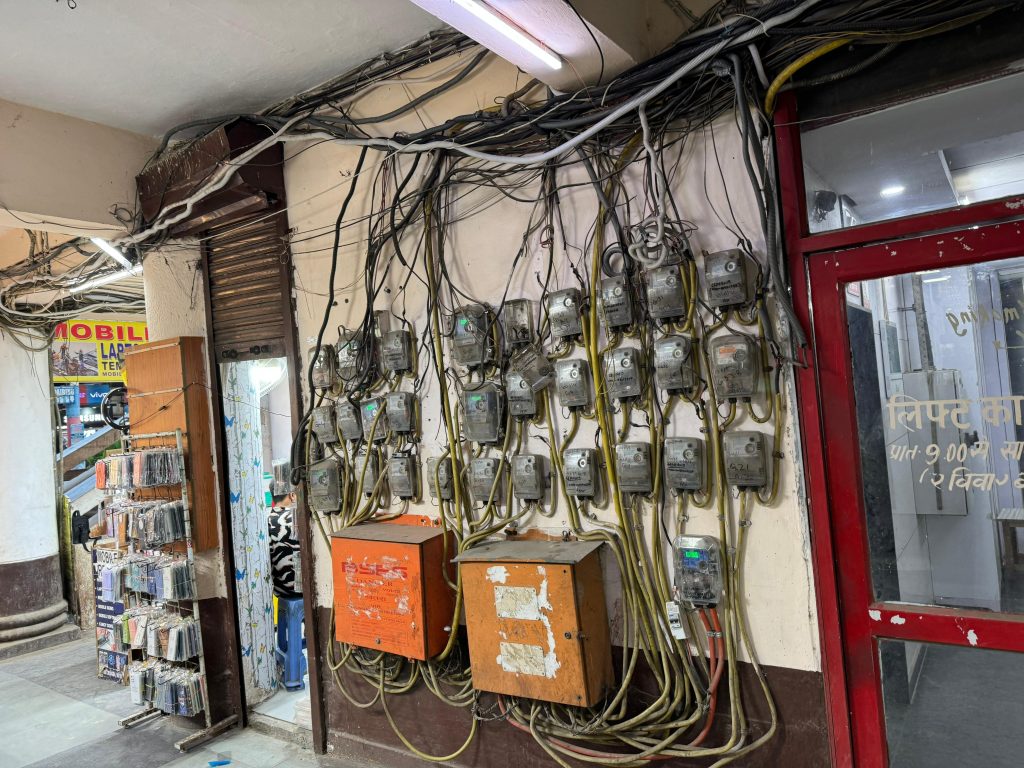
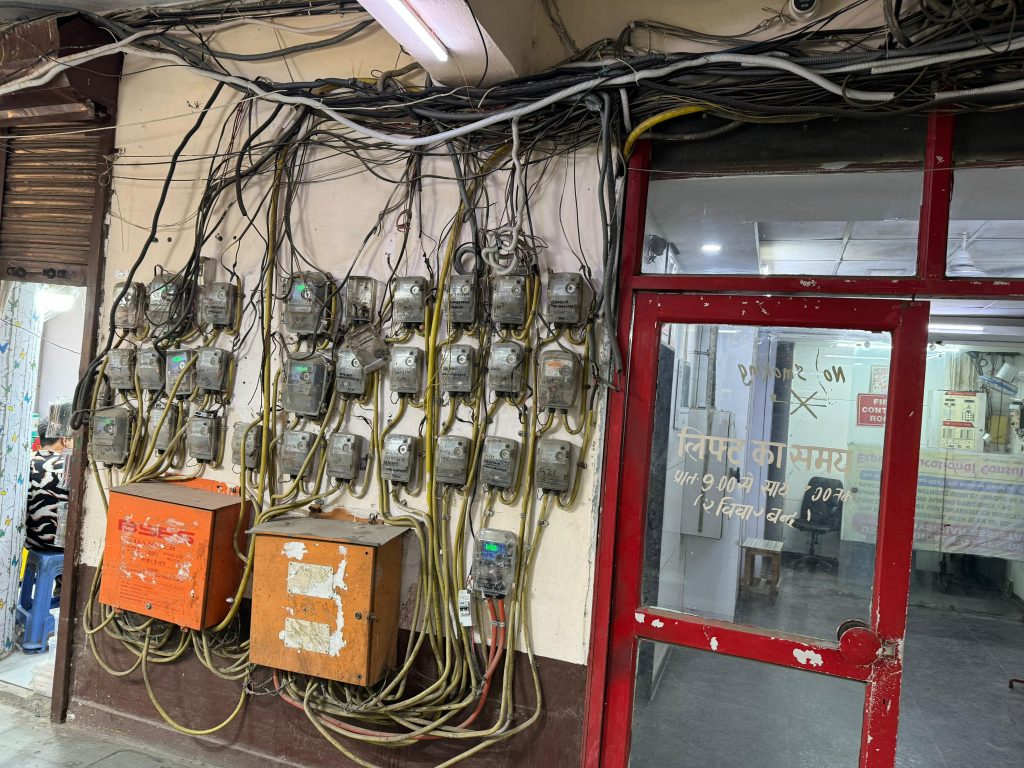
(Ground-floor corridor, Jaina Tower II — July 2025)
What you’re looking at
Right where residents and shoppers should have a clear path, the builder has mounted nearly three dozen live electricity meters, two rusty distribution boxes, and a spaghetti-tangle of exposed cables. The original, code-compliant meter room has been gutted and the freed-up space quietly sold off as yet another kiosk. Profit for the developer, peril for everyone else.
Why this is flat-out illegal
| Rule broken | What the rule says | How the photo violates it |
|---|---|---|
| BSES Rajdhani Metering Guidelines | “Meter must not be installed in staircase / common entrance / corridors.” (BSES Delhi) | All meters have been fixed exactly in the common corridor that doubles as a fire-exit path. |
| National Building Code of India, Part 4 (Fire & Life Safety) | Exit routes must remain “without obstruction or undue congestion in the path of travel.” (Fire and Safety Equipments) | Bulky boxes and looping cables narrow the corridor and could ignite, blocking evacuation. |
Bottom line: Every minute these meters stay here, the building is in technical violation of both electrical-safety and fire-safety codes.
The hidden dangers
- Flash-over & Fire Spread – Bare joints and loosely taped splices can arc. With the entire bundle sitting against a paint-finished wall, one spark could engulf the passage in toxic smoke within seconds.
- Electrical Shock – Anyone brushing past a nicked cable risks a 230-volt jolt. The boxes sit at shoulder height for adults and eye level for kids.
- Obstructed Egress – In a panic, evacuees will funnel through this corridor. Burning insulation or sparking boards could trap them at the very spot meant to lead them out.
- Maintenance Nightmare – Utility engineers cannot safely isolate one meter without shutting down the whole bank. Emergency repairs will be slow and hazardous.
- Insurance & Liability – Insurers routinely reject claims when statutory norms are flouted. Owners could find both property and life-cover policies void.
How the builder benefits — and why you shouldn’t look away
Relocating the meter room unlocked prime, rent-generating floor space. On paper it looks like “remodelling”; in reality it converts mandatory service space into a cash register while off-loading all risk onto occupants.
What owners, tenants, and visitors can do
| Step | Who can act | How it helps |
|---|---|---|
| File a written complaint with BSES & DERC | Shop-owners / RWAs | Utilities can disconnect supply or impose penalties until the meters are shifted back to a dedicated, fire-rated room. |
| Escalate to Delhi Fire Service | Any occupant | DFS can issue a notice under NBC Part 4 and even order sealing of unsafe portions. |
| Commission an independent Electrical & Fire Audit | RWA / individual owners | Provides documented proof of non-compliance — critical if litigation or insurance claims arise later. |
| Demand restoration of the original meter room | Collective owners | The developer must reinstate a ventilated, lockable meter enclosure with FRLS (fire-retardant low-smoke) cabling. |
| Spread the word | Everyone | Share photos and this write-up. Transparency is often the quickest route to corrective action. |
Final thoughts
Moving essential infrastructure into public escape routes is more than a shady real-estate hack — it is an open invitation to disaster. Until the meters are relocated to a compliant, fire-rated room, Jaina Tower’s ground-floor corridor remains a corridor of sparks. If you own, rent, or even visit this building, raise your voice now — before a short-circuit writes the next headline.