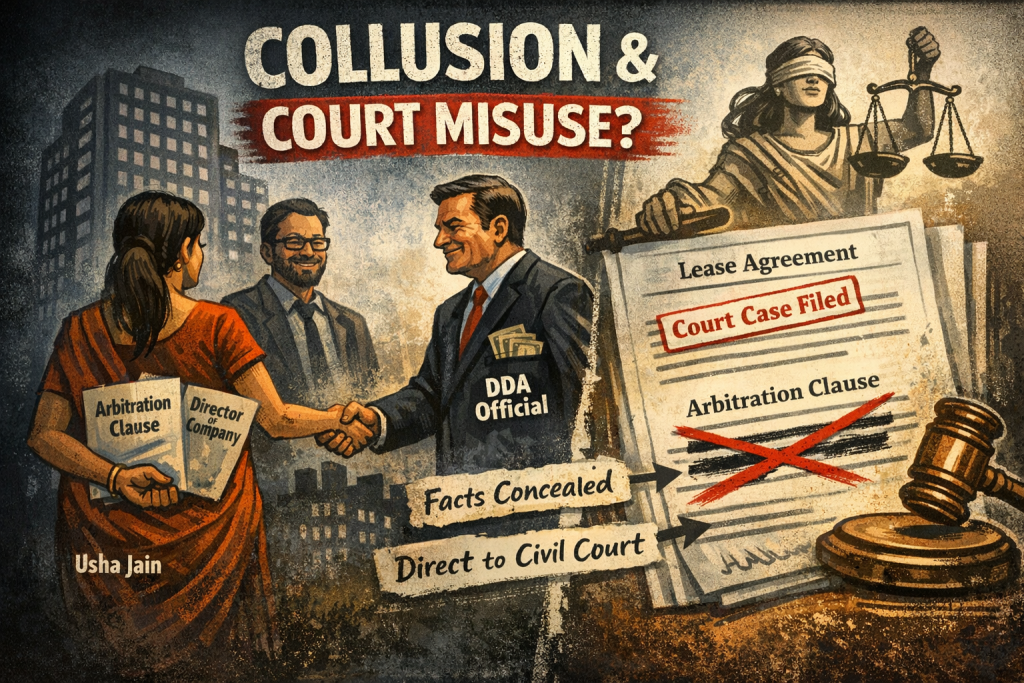
Property disputes in Delhi often reveal more than simple disagreements over ownership. In some cases, they expose how legal processes can be manipulated through concealed facts, strategic litigation, and institutional collusion.
One such example appears in the case of Smt. Usha Jain vs State, where a court granted a declaration presuming a missing person dead.
At first glance, the case appears routine. But a deeper examination raises serious questions about the use of litigation to strengthen property control while hiding crucial facts from the court.
The Case: Declaring a Missing Person Dead
The lawsuit was filed by Mrs. Usha Jain and her son, asking the court to declare her husband Jagmander Das Jain legally dead after he had been missing since 1996.
Under Section 108 of the Indian Evidence Act, courts may presume death if a person has not been heard from for seven years.
Because no opposing party appeared in court, the case proceeded ex-parte, and the judge granted the declaration.
On paper, the legal reasoning was straightforward.
But the real story may lie in what the court was not told.
The Missing Context: Company Control and Builder Agreements
In disputes involving perpetual lease properties in Delhi, especially those connected to DDA-leased land, ownership and dispute resolution are often governed by arbitration clauses embedded in lease deeds or builder agreements.
In many such cases:
- The builder or developer company is bound by arbitration clauses.
- Disputes between parties cannot be directly taken to civil courts.
- Buyers themselves often have no direct contractual relationship with DDA.
If such facts exist, they are critical to the court’s jurisdiction.
Yet in several disputes around perpetual lease properties, litigants have allegedly approached courts while concealing their roles as directors or controlling members of the builder company.
When that happens, the court may unknowingly hear a matter that should legally have been resolved through arbitration rather than litigation.
A Pattern Seen in Builder Disputes
Cases tied to controversial builder disputes in Delhi often reveal similar patterns:
- Concealment of corporate roles
- Individuals file cases as private occupants while also being directors of the builder company.
- Ignoring arbitration clauses
- Agreements governing the property contain mandatory arbitration provisions.
- Litigation instead of arbitration
- Despite the clause, parties initiate civil suits to obtain favorable orders.
- Ex-parte orders
- When opposing parties are not effectively notified, courts may grant relief without hearing the other side.
These tactics can dramatically reshape control over valuable commercial properties.
The Role of DDA in Perpetual Lease Properties
Another critical element in these disputes is the Delhi Development Authority (DDA).
In perpetual lease properties:
- The land technically remains under DDA’s ownership.
- Builders operate under strict lease conditions.
- Buyers usually have agreements only with the builder, not directly with DDA.
This means private buyers cannot independently enforce rights against DDA unless a clear contractual relationship exists.
If litigation proceeds without acknowledging these legal structures, the court may be presented with an incomplete picture of the dispute.
Why These Issues Matter
The justice system depends on full disclosure of facts.
When litigants conceal:
- corporate positions,
- arbitration obligations,
- or the true structure of property ownership,
courts may unknowingly issue orders that distort property rights and encourage further litigation.
Even worse, once a favorable order is obtained, it may become the basis for additional lawsuits, eviction attempts, or enforcement actions against other occupants.
The Larger Lesson
The case of Usha Jain vs State highlights a broader issue in Delhi’s property litigation landscape.
Many disputes are not simply about missing persons or inheritance.
They are about control over valuable urban property, and the legal system can become a battlefield where facts are selectively presented and procedural advantages are exploited.
Greater scrutiny of builder agreements, arbitration clauses, and corporate relationships is essential if courts are to prevent manipulation of the judicial process.